$299
One-time price per Umbraco installation with a perpetual license model.
On-premise Umbraco delivery
Bring server-driven native UI into your own Umbraco stack.
Self-Hosted keeps the FastGooey rendering model but removes the SaaS dependency. Install the package in Umbraco, manage content in your own environment, and deliver native iOS and macOS experiences from infrastructure you control.

Ideal for agencies, enterprises, and teams that need data sovereignty, controlled hosting, or procurement-friendly perpetual licensing.
$299
One-time price per Umbraco installation with a perpetual license model.
0 SaaS fees
Run the content workflow without ongoing hosted-platform subscription costs.
Umbraco-native
Integrate as a standard package and keep working in the CMS your team already knows.
Native output
Deliver true UIKit and AppKit experiences from your self-managed content pipeline.
FastGooey Self-Hosted is for teams that want the content-to-native pipeline without sending operational control to a hosted service. It fits organizations already standardized on Umbraco and those with stricter infrastructure or compliance needs.
Best fit
Install FastGooey as a NuGet package in your existing Umbraco project, keep your content operations in familiar tooling, and expose that content to your native apps without depending on a third-party cloud runtime.
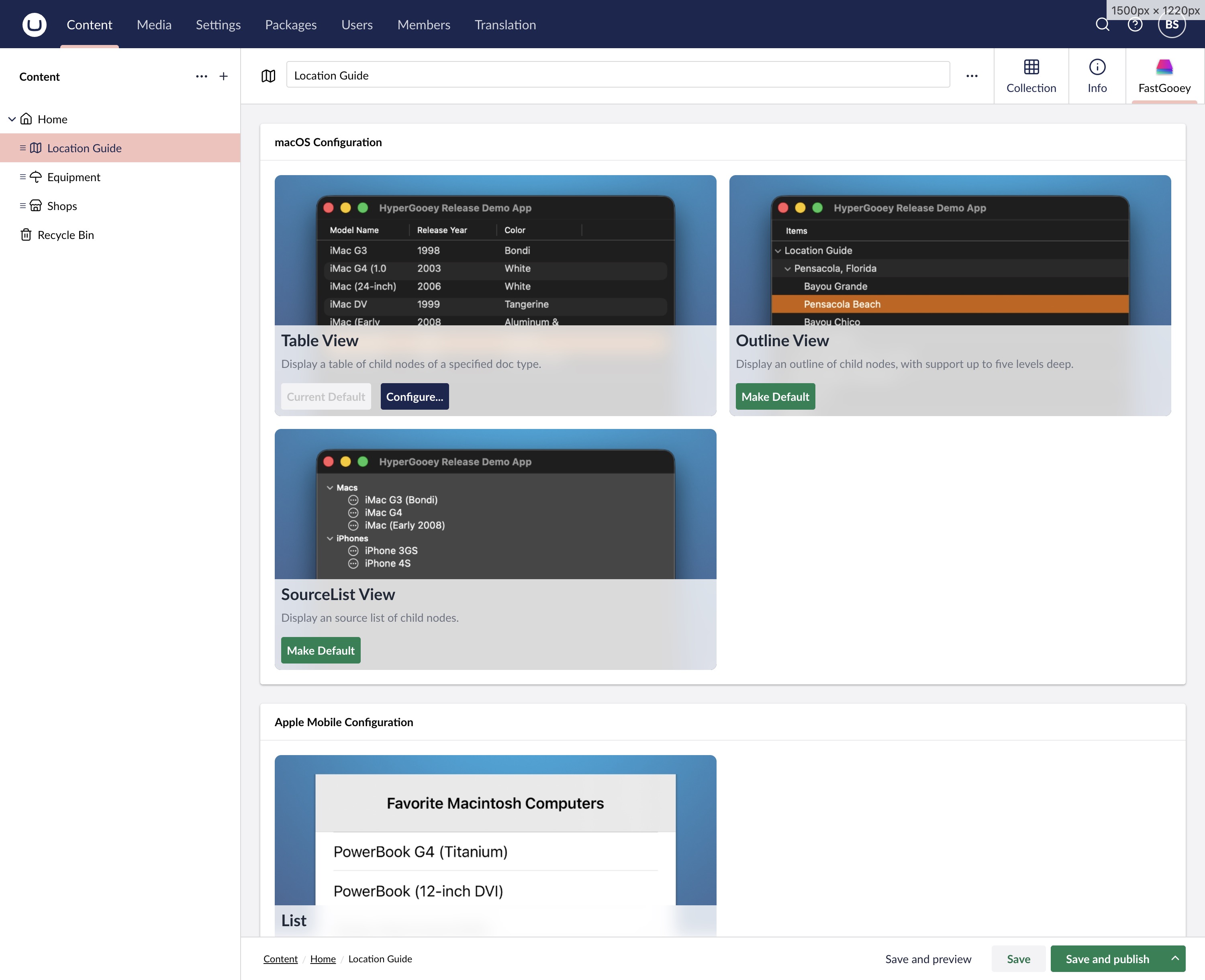
Use Umbraco as the authoring environment, keep the content model close to your existing editorial workflow, and publish to native apps from there.
Configure the package in Umbraco, define the interface, and mount the client in your native app.
Editors work in your own CMS environment while the app team consumes a stable interface endpoint.
Implementation
Once the interface is defined, the native client integration remains small. That keeps the self-hosted deployment operationally flexible without bloating your app layer.
#import <HyperGooey/HyperGooey.h>
HyperGooeyViewController *hyperGooeyViewController = [[HyperGooeyViewController alloc] initWithUrl:@"https://{your-umbraco-host}/hypermedia/{my-interface-id}"];
[self.hyperGooeyViewController mountInContainer:self.window.contentView
parent:self.window.contentViewController];Self-Hosted focuses on the core native rendering surfaces most teams need first, with the same emphasis on native fidelity as the hosted platform.
Table View, SourceList View, and Outline View for desktop-grade information architecture.
List View support for mobile delivery, with the same native rendering approach as the hosted model.
Package-based installation, private hosting, and a deployment shape that works cleanly in enterprise environments.
The commercial model is deliberately simple: pay once per website and keep the package in your stack.
What you buy
FastGooey Self-Hosted is $299 per Umbraco installation. You own the license outright, with major upgrades included for the first year and optional paid support thereafter.
What changes operationally
Your ongoing costs are your own hosting and operational overhead. There is no monthly SaaS subscription attached to the self-hosted package.
Prefer managed hosting?
The hosted service removes the Umbraco installation and maintenance burden while expanding the platform footprint. Starting at just $29 per workspace per month.
Need implementation help?
Purchase the license, install the NuGet package into your Umbraco project, and use the HyperGooey documentation to wire the native client into your app.
It is aimed at agencies, enterprises, and teams that need data sovereignty, private infrastructure, or a non-SaaS procurement model while still wanting native app rendering.
The core difference is operational ownership. Self-Hosted runs in your Umbraco environment and avoids recurring platform fees, while hosted FastGooey removes the infrastructure work.
Install it as a standard NuGet package in your existing Umbraco CMS instance, configure the content model there, and point your native app at the self-hosted endpoint.
Self-Hosted currently supports core macOS views like Table, SourceList, and Outline, plus iOS List View, with native UIKit and AppKit output.